The Matchday Packing List That Brings Too Much
A matchday packing list built around the day’s actual plan helps you carry personal essentials without hauling gear for every imagined mishap.
Your matchday packing list should fit the fixture, not every mishap you can imagine. Before you reach for a second bag, check the start time, venue, weather and what the club or host has asked you to bring. Those details give you a smaller, more useful set of personal essentials.
Overpacking often begins with a reasonable thought: what if the weather turns, the match runs late or someone needs something? The trouble is that each possibility adds another item, while the bag still has to be carried from the car park to the boundary, pavilion or touchline. A simple routine can keep preparation focused on the day you actually have.
What is already settled for matchday?
Start with the information that is firm, not the scenarios that are only possible. Check the fixture message, club notice or event details for the venue, your role, arrival time and any instructions about clothing or equipment. If you are playing, your sport-specific kit belongs on the list. If you are watching or helping, do not pack a player’s gear just because it might come in handy.
Next, consider the journey and facilities. A short walk from a nearby car park calls for different carrying choices than a long trip between fields. Check whether you can use a changing room, refill a water bottle or leave a bag somewhere appropriate. If that information is missing, ask the organizer rather than packing supplies to cover every answer.
Separate the list into three simple groups:
- Required: items the fixture or your role calls for.
- Personal essentials: things you use during an ordinary matchday, such as your usual drink or a layer you need to stay comfortable.
- Optional: items that solve a particular, likely need but can stay home otherwise.
Keep the optional group small. “Might be useful” is not a reason on its own; connect each item to a known part of the plan.
What should you decide during the week?
When the fixture is confirmed, make a quick note of the essentials. This is the time to notice a special kit requirement, a change of venue or a request from the club. Do not build a separate emergency bag for an ordinary outing. If you have a recurring personal need, include it because it is part of your routine, not because you are preparing for every unlikely event.
A day or two before the match, check the forecast and any updated fixture messages. Use the forecast to choose clothing, not to add a complete second outfit for every possible shift in conditions. A rain shell may make sense for an exposed ground; spare warm layers may be unnecessary if you will be indoors or have an easy route back to your vehicle.
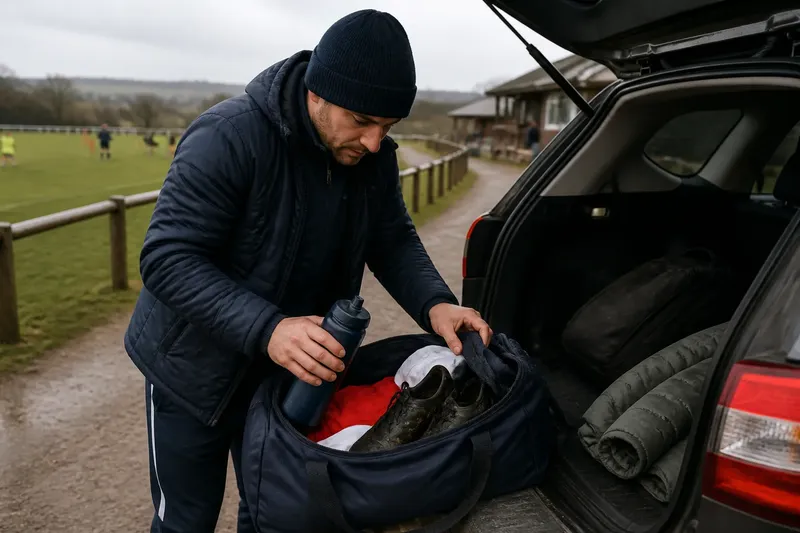
Say you are driving to a morning match at a familiar ground, playing your usual role and expecting changeable weather. You check the fixture, see no special equipment request and choose your playing kit, water bottle, snack, coat and the footwear required for the ground. Instead of packing another set of clothes, a spare umbrella, extra snacks and several tools “just in case,” you leave them at home. The bag now reflects the known plan, while the coat covers the weather concern you actually checked.
How do you make the final packing decision?
On the evening before, gather only the items on your short list. Put required kit together so it is easy to see, then add the personal items you expect to use. Keep keys, phone and wallet in their usual place rather than burying them under equipment.
Before closing the bag, ask these questions:
- Is this item required for my role or named in the event instructions?
- Do I expect to use it under the conditions currently forecast?
- Is it already available at the venue or in the vehicle?
- Am I packing it for a specific reason, or because I can imagine a problem?
If the only answer is that something could happen, leave the item out unless it is a regular personal essential. This is a useful distinction: preparation responds to a plausible need; overpacking tries to eliminate uncertainty by carrying more.
What can you leave out without feeling unprepared?
Start with duplicate items. A second bottle, another snack and multiple layers can quietly turn a compact bag into a store of backups. Keep a spare only when it answers a clear need, such as a known long gap between matches or a personal requirement you rely on.
Then look at equipment that belongs to someone else’s role. Spectators rarely need player supplies, and a player does not need to carry club equipment that the organizer has arranged. If you are helping, pack the specific materials you agreed to bring instead of taking a general collection of supplies. Confirm unclear responsibilities with the person coordinating the day.
Finally, resist packing for a change of plan that has no practical cue. If the match is postponed or the venue changes, a message from the club can guide your next decision. A bag full of contingency items will not make an uncertain fixture clearer.
How can you adjust the list after each match?
When you get home, unpack promptly and notice what stayed unused. One unused item does not automatically belong on the cut list; it may have been sensible for that day’s conditions. But if something repeatedly travels back and forth without serving your role or comfort, remove it from the standard list.
Also note what you genuinely needed but had not considered. Add that item only when it fits your normal matchday or a recurring feature of the fixture. This keeps the list personal rather than turning it into a general catalogue of possible problems.
What do matchday packing questions usually come down to?
Should you pack a spare outfit?
Pack one when your role, the event instructions or a known change of conditions makes it useful. For a routine outing, the kit you will wear and a suitable outer layer may be enough.
How much food and drink should you bring?
Bring what suits your usual needs and the day’s schedule. Check whether refreshments or refill options are available, then avoid adding extra supplies without a clear reason.
What if the weather forecast changes?
Check it again before leaving and adjust the clothing you will actually use. If conditions raise a question about the fixture itself, follow the organizer’s updates instead of packing for an event that may not go ahead.
Should every family member use the same list?
Use one shared core for common items, then add each person’s own essentials and role-specific kit. That avoids duplicate supplies while respecting different needs.
A useful matchday packing list is not the one that covers every imaginable situation. It is the one that reflects the confirmed plan, supports your own needs and leaves out items with no clear job. Check the fixture, pack with purpose and review the bag after the day; the next matchday list will be easier to trust.